Most beginners who are stuck on a niche have plenty of ideas. They have four or five, and each one looks promising until a doubt appears: someone else already writes about it, or it might run out of things to say, or something more interesting comes along. Picking one starts to feel like a decision you could get wrong for good.
You can make the decision without that worry. Run each candidate through the same short check, compare the results, and choose the one that scores best. This article covers how to choose a niche for affiliate marketing in a way you can repeat, finish in a few days, and revisit later without starting over.
Why waiting for the perfect niche is the slowest choice you can make
Thinking about a niche gives you very little new information after the first hour. The information that matters comes from doing things: writing about the topic, noticing which questions come easily, and seeing how a recommendation reads when it sits next to a real answer. None of that is available while you are only deliberating.
Starting also teaches you skills that belong to no particular niche. Planning an article, writing it clearly, publishing it and adjusting it afterward work the same way whether the site is about gardening or personal finance. Those hours are not wasted if you later change your topic.
The cost of a wrong choice is also lowest at the beginning. A site with five articles can be narrowed, widened or redirected in an afternoon. A site with two hundred cannot. The longer you wait to start, the more of that cheap flexibility you leave unused.
If you want the longer argument about why a flawless niche does not exist, the article on affiliate marketing myths for beginners covers it. What follows is the practical part: a method that replaces the search for the perfect answer with a good enough one.
Start with a list of ten, not a single idea
Holding one idea in your head makes it feel like a verdict. You either love it or you find its flaws, and you have nothing to compare it with. A list of ten gives you something to compare, and comparing is easier than judging.
Set a timer for fifteen minutes and write down ten possible topics. Do not edit while you write. These prompts help when the list stalls:
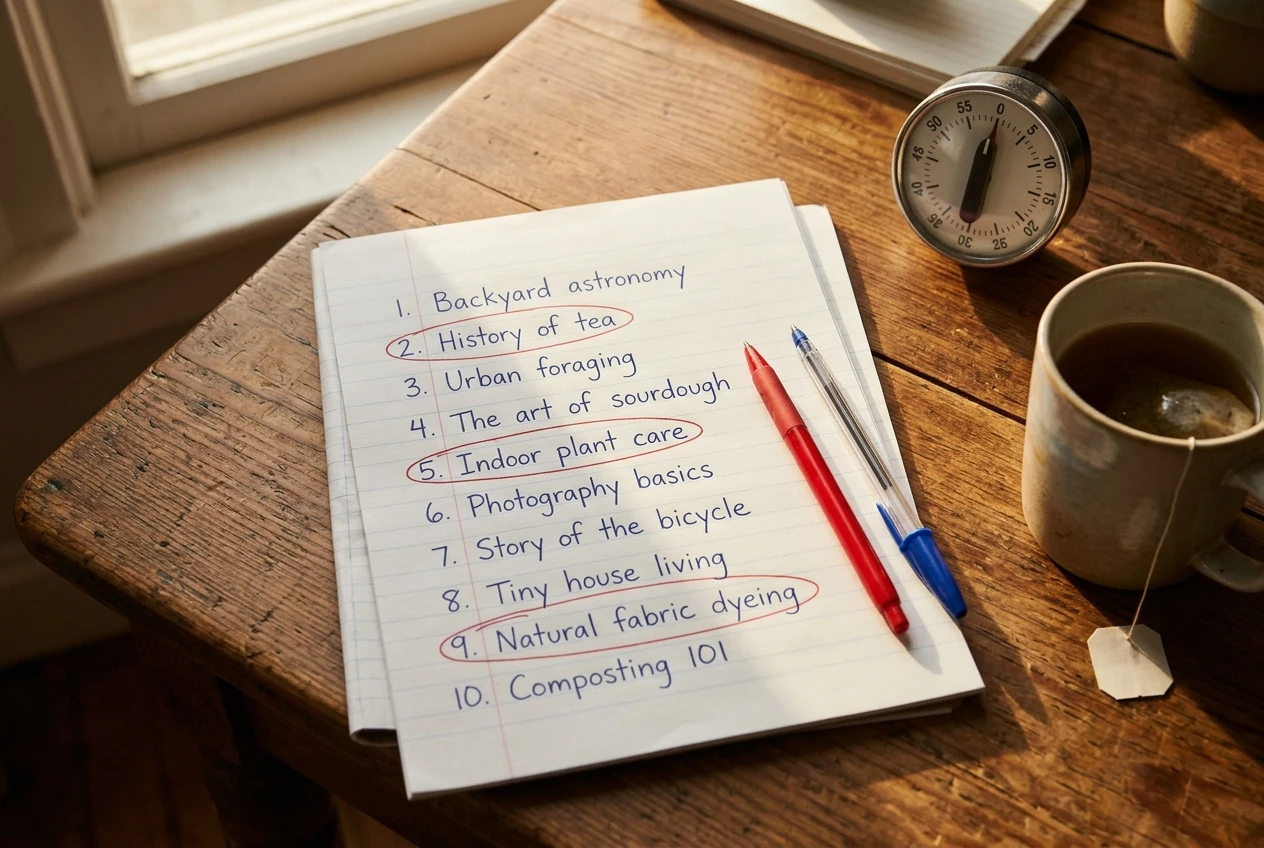
- Subjects you read, watch or listen to without being asked to.
- Problems you have solved for yourself or for other people.
- Skills you have, even modest ones, and skills you are actively picking up.
- Things people tend to ask you about.
- Stages of life you know well, such as starting a new job, caring for a pet or moving house.
Make some entries broad and some narrow. “Dogs” is broad. “Settling an adopted rescue dog into a new home” is narrow. Beginners often do better with the narrow version, because a small topic has a clear reader, and a clear reader makes every other decision easier. You can always widen a niche later, but narrowing one that was too broad means rewriting what you have built.
When the list is done, read it once and mark the three entries you would least mind spending the next few months on. Use instinct for this step. The checks come next, and they will do the rigorous work. Three candidates are enough to compare without overwhelming you.
The five checks that turn a list into a shortlist
Each check asks one question about each candidate, and you score the answer from 1 (weak) to 5 (strong). Write the scores in a simple grid with your three niches down the side and the five checks across the top. The scores are rough on purpose, and the grid mostly shows you where each niche is thin.
- Genuine interest. Could you read and write about this topic for several months and still find new corners of it interesting? A 5 means you already follow it without being asked. A 1 means you like the idea of it more than the subject itself.
- Number of questions you could answer. If a beginner arrived with twenty questions about this topic, how many could you answer well, or answer after an hour of reading? This check has its own exercise, covered below.
- What readers would need help with. Are the questions beginners ask about this topic ones where they are stuck, choosing between options, or trying to fix something? People who need help act on answers. People who are only mildly curious tend to read and leave.
- How a product fits. Is there an honest place in your articles where recommending a product, service or tool would help the reader? You can check this before you write anything, as the section on natural recommendations shows.
- A small test. If you write one real article in this niche, what happens to your energy and your confidence? A 5 means you finished with more ideas than you started with. A 1 means every paragraph felt like a chore.
Checks 1 and 5 measure you, checks 2 and 3 measure the topic, and check 4 measures the link between the topic and the way a site like this earns. A niche that scores well on only one of these groups has a weakness you can see before you build anything.
Run the evidence test: write down twenty questions a beginner in each niche would ask
This exercise covers checks 2 and 3 together. For each of your three candidates, set a timer for twenty minutes and write twenty questions a total beginner in that niche might ask. Write them in the plain wording a beginner would use, not in the vocabulary of someone who has been in the field for years. “Why does my sourdough starter smell like nail polish remover?” is a better question than “What are the indicators of an over-fermented culture?”
If you stall before ten, that tells you something. Either the niche is narrower than you realised, or you do not yet know enough about what beginners in it struggle with. Both can be fixed, but you should know which one it is before you commit. If the questions come quickly, notice that too.
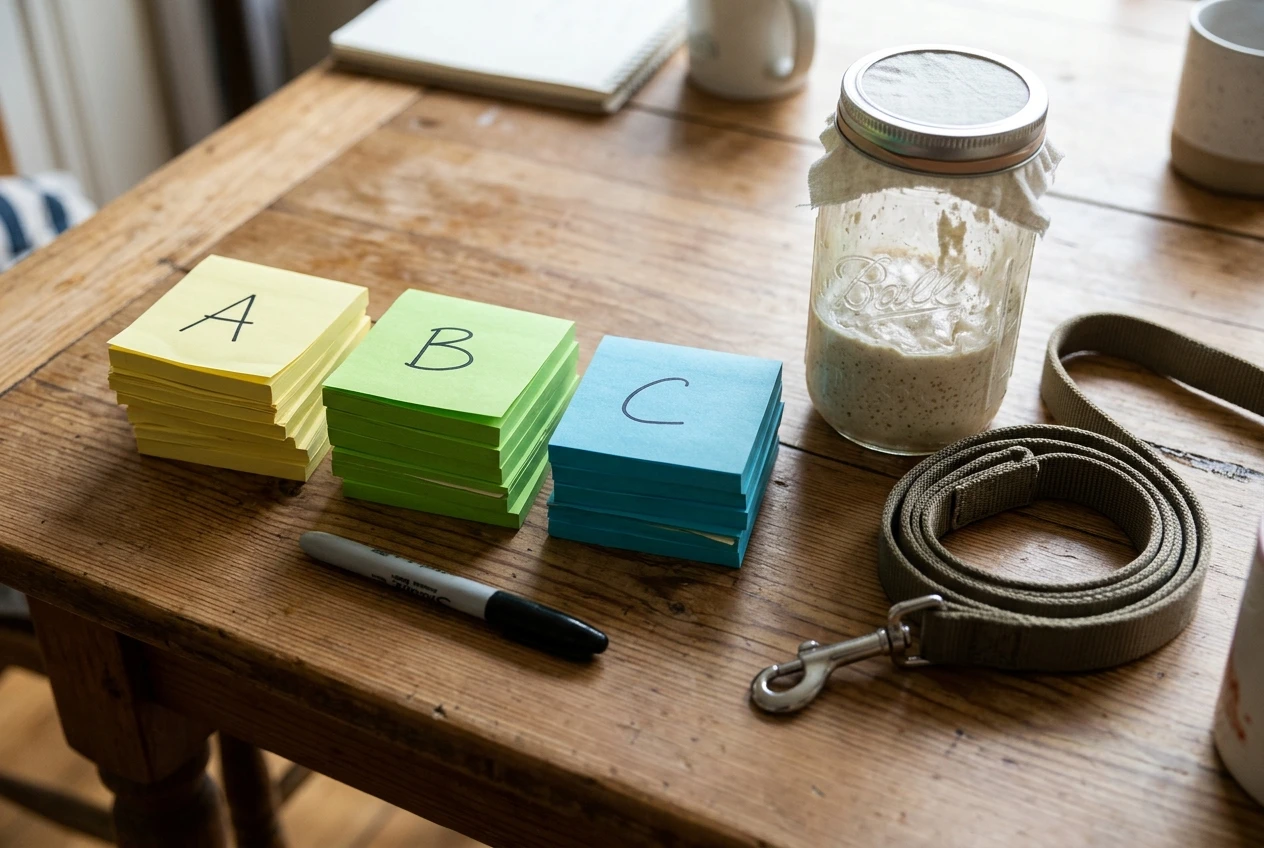
When you have twenty questions for a niche, go through them and mark each one:
- A: I could write a useful answer today.
- B: I could write a good answer after an hour or two of research.
- C: I would have no idea where to start.
Count each group. A niche with plenty of A and B questions and only a few C questions is one you can start writing in now. A niche that is mostly C is not a bad niche. It means you would spend the first months studying before you could help anyone, which is a real cost to weigh against your interest in it.
Now read the questions a second time and look at what kind of help each one asks for. Some are about doing something (“How do I…?”). Some are about choosing (“Which is better for…?” or “Should I buy…?”). Some are about fixing a problem (“Why does… keep happening?”). Questions of these types come from people who are stuck and want to move. Questions that are only “What is…” or “Why do people say…” come from people who are browsing. A strong niche has a good share of the first kind.
Give each niche a score from 1 to 5 for check 2 based on your A, B and C counts, and a score for check 3 based on how many questions came from people who needed to decide or fix something.
See where recommending something would feel natural, not forced
Check 4 is the one beginners most often skip, and it is where a niche can look good on paper and still not work for a site that earns through recommendations. You can test it before you write a single article, using the questions you already have.
Take the ten questions from each list that you scored highest. For each one, try to complete this sentence: “A reader who asked this would be better off with ____, because ____.” The blank might be a physical product, a piece of software, a course, a service or a membership. The “because” has to be a reason you could say to the reader’s face.

If you can complete the sentence for several questions, with different answers rather than the same one every time, the niche gives you natural places to recommend things. If you can complete it for only one or two, the niche may be pleasant to write about but offer few honest openings. If you can complete it only by stretching, so that the recommendation does not really answer what the reader asked, that is the sign of a forced fit. Readers notice forced recommendations, and they stop trusting the answers around them.
A few points keep this check honest:
- Look up how the affiliate program for a product actually works on the program’s own page before you count it as a fit. Terms, rules and payment arrangements differ from one program to another, and you should not assume.
- Recommend only what you have checked. If you have not used a product, say so, and describe what you did look at.
- A product that fits a beginner’s question today should still make sense to recommend in a year. A recommendation that depends on a short-lived trend is a weaker foundation.
Score each niche from 1 to 5 on this check. A niche with many natural openings and a topic you find interesting is a strong candidate even if its other scores are middling.
Choose one for ninety days and decide in advance how you will review it
By now you have a grid of scores for three niches, with four of the five checks filled in. Check 5, the small test, is the last one and takes the most time, so use it to separate your top two rather than all three.
Take the two highest-scoring niches and write one full article in each, picking a question from your A list. Do not publish them yet if you are not ready. Notice what happens while you write. In one niche, you may find yourself adding a second and third section because you know more than you thought. In the other, you may be stalling after the first paragraph. Score both on check 5.
Then add up the totals and choose. If two niches finish within a point of each other, pick the one that scored higher on check 1. You will spend far more hours on the site than anyone else will, and interest is what keeps those hours going on weeks when nothing seems to be happening.
Write the decision down
Before you build anything, put the following on one page where you can see it:

- The niche, in one sentence, including who it is for. For example, “Helping people who have just adopted a rescue dog get through the first month.”
- The reason you chose it, taken from your scores.
- The review date, which is ninety days after you publish your first article.
- The number of articles you will have published by then. Pick a figure you can keep up with on your busiest weeks. The article on how many hours a week starting online really takes can help you set a realistic number.
Decide what the review will ask
Settle the review questions now, while you are calm, rather than during a week when the site feels empty. Four questions are enough:
- Did I publish the number of articles I planned?
- Do I still have questions left on my list, or have I found new ones?
- Do I still find the topic interesting enough to carry on?
- Have I found places where recommending something helps a reader?
If the answer to the first question is no, the problem is probably your schedule and not your niche, so fix the schedule first. If the answers to the second, third and fourth are mostly yes, stay where you are. If they are mostly no, you have real evidence for a change, and the change can usually be a narrowing or a shift to a neighbouring topic rather than a restart. You will also have kept every skill and every article that taught you something.
Ninety days is long enough to see whether a niche works for you, because the early weeks are mostly spent finding your bearings. The stages by name are getting your bearings, opening the doors, meeting your first readers, earning a little trust, and helping them take a step. Each of these takes time, and none of them can be judged properly in the first fortnight. The article on what your first 90 days of affiliate marketing can realistically look like walks through those stages in more detail, so you know what to expect at each point.
Choosing a niche this way gives you something the endless search never does, which is a decision with a date attached. You are not promising to stay in the niche forever. You are agreeing to give it a fair trial, and to look at what happened with the review questions in front of you.
Write down your three candidate niches today, then bring them into Wealthy Affiliate, where you can build your first site and talk the choice over with other beginners who are choosing too.