Most advice about time and affiliate marketing is written for someone with a free afternoon. If your good day gives you thirty minutes, that advice leaves you feeling behind before you have started. Time management for new affiliate marketers works differently: the question is how to make a small, fixed amount of time reliably useful, not how to find more of it.
This article gives you a way to do that. It covers choosing a session length, giving each session a single job, setting up a weekly rhythm, and picking things back up after a missed day. If you want the number of hours that starting online usually takes, this straight answer on weekly hours covers it, so here we focus on how to use the time you have.
Why a small session you actually keep beats a big plan you don’t
A plan to work three hours every evening sounds serious. It also collapses the first time a child gets sick, a shift runs late, or you are simply tired. Once it collapses, the whole plan feels broken, and many beginners stop at that point.
A thirty-minute session survives bad weeks. It fits between dinner and the dishes, or before the house wakes up. Because it is small, skipping it takes a real reason, and starting it takes almost no willpower.

There is also a practical benefit. Work you touch several times a week stays fresh in your head. You do not spend the first twenty minutes of a long, rare session remembering where you stopped. Short sessions repeated often keep your place for you, and the progress adds up faster than the minutes suggest.
So the first decision is to choose a session size you could keep on a rough week, not on your best one. If thirty minutes feels like a stretch, choose twenty. You can always run over when things go well, and running over feels much better than falling short.
Find your real thirty minutes: a gentle audit of the week you already have
You probably have more usable pockets than you think, and fewer than you hope. An audit shows you which ones are real.
Take a piece of paper and sketch last week in rough blocks: work, commuting, meals, children or other people who depend on you, chores, sleep, and whatever you do to unwind. You are not looking for things to cut. You are looking for where thirty minutes already exists, even if something else is using it right now.
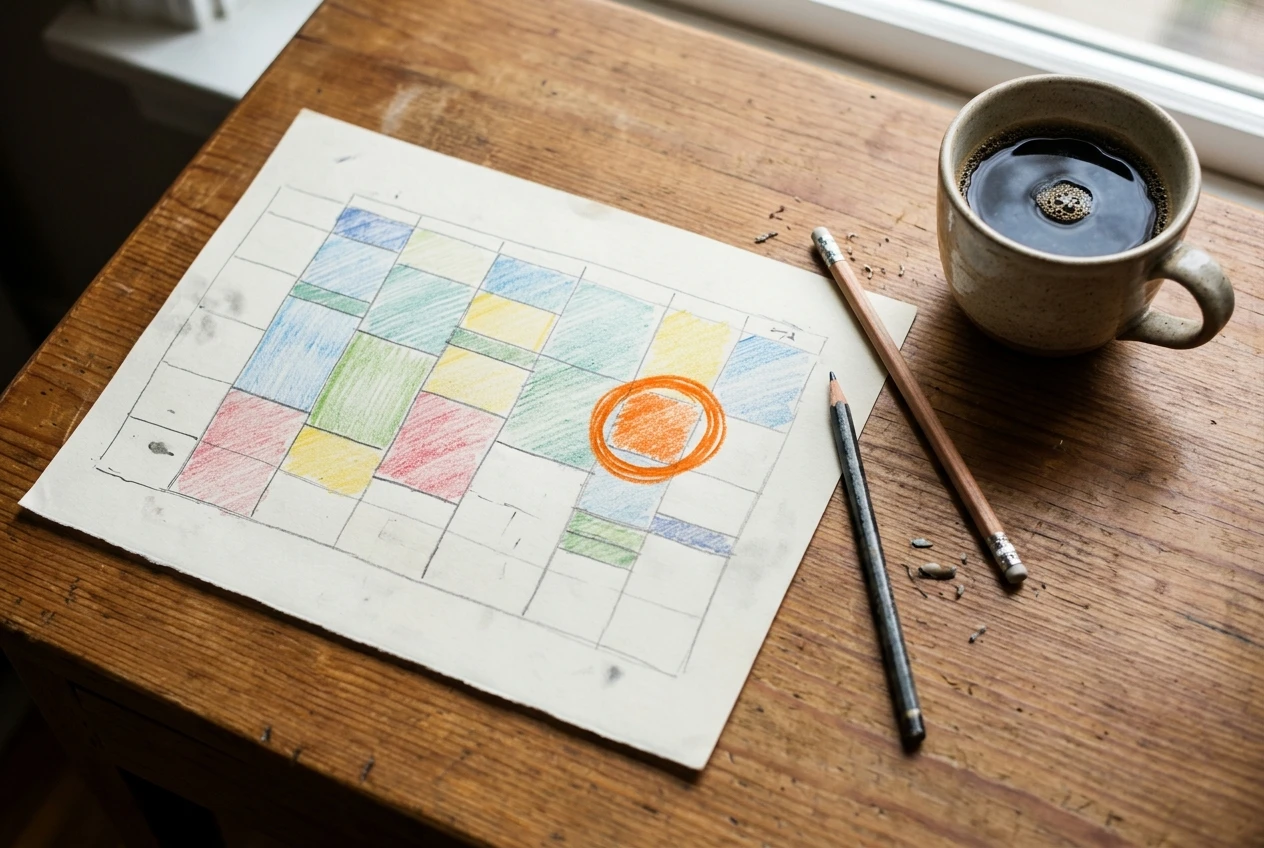
Common candidates include:
- The half hour before everyone else is up
- A lunch break, if you can take it away from your desk
- The stretch after the evening routine winds down
- A passenger commute on a train or bus
- A fixed slot on a weekend morning
For each candidate, ask two questions. First, how often is it truly free: most days, or only now and then? Second, what is your head like at that time? Writing and building a website need some focus, so a slot where you are exhausted may suit lighter jobs like watching a lesson or jotting notes.
Choose a first slot that is free most days and fits your energy. Then choose a backup slot for the days the first one falls through. Two named slots take away the daily argument with yourself about when you will do it.
Do not borrow the time from sleep. A tired person does thirty minutes of poor work and then resents the whole project. If the only way to find the time is to sleep less, you probably need a smaller session, not a heroic one.
Give every session one job so you never sit down wondering where to start
Beginners lose a surprising amount of their thirty minutes to deciding what to do. You open the laptop, look at a list of everything that could be done, and half the session goes on choosing and worrying. A session with one assigned job removes that.
The rule is simple: before you sit down, you already know the single thing this session is for. A job should be small enough to finish or clearly advance in thirty minutes. These examples show the right size:
- Watch one lesson and write down one thing you will try
- Choose the topic for your next article and write its headline and a rough outline
- Write the first half of a post
- Finish and publish a post you drafted earlier
- Set up one piece of your site, such as a page or a menu
Notice that each one has an obvious end. “Work on my website” has no end, so it never feels done and never feels like progress. “Write the introduction and two section headings” can be checked off.
The simplest way to always know the next job is to set it up at the end of each session. In the last two minutes, write one line saying what the next session is for and where you stopped. Next time you open your notes and begin. That one line is the best two minutes you will spend all week.

A simple weekly rhythm: learn, build, publish, and rest
Once every session has one job, the jobs can follow a rhythm. Four kinds of session cover what a beginner needs, and they repeat well.
Learn. Watch or read one piece of training and take a single idea from it. Keep it to one. Collecting ten ideas in a session feels productive and produces nothing you can use.
Build. Do the hands-on work: shaping your site, planning content, drafting. This is where most of your sessions will go in the early weeks.
Publish. Finish something and put it where people can see it. Publishing is a skill of its own, and it only improves by doing it. A finished, imperfect post teaches you more than a perfect draft that sits unpublished.
Rest. Plan at least one day with no session. This is part of the schedule, not a gap in it. A rest day means that missing a session elsewhere does not make you feel you have failed.
A week for someone with four good slots might look like this: learn on Monday, build on Tuesday, build on Thursday, publish on Saturday, with the other days left free. Someone with three slots can drop a build session. Someone with two can alternate, learning one week and building the next. The order matters less than the habit of knowing which kind of session each slot is.
If you want to see how these habits can be spread across your opening month, the first 30 days guide lays out one small habit per week, and it pairs well with this rhythm.
What to do when you miss a day (or a whole week)
You will miss sessions. Illness, deadlines at work, a house full of visitors: ordinary life takes the slots you chose. What matters is what you do next, because the usual reaction is the one that does the damage.
That reaction is to feel guilty and decide to make up for lost time with a double session. Doubling up on a day when you are already behind and tired rarely works, and when it fails it adds more guilt. Skip the catch-up entirely. The schedule does not owe you the missed session.
Instead, restart with the smallest version of the next job. If your notes say the next session is to finish the second half of a post, write one paragraph. If a whole week has gone, try a ten-minute session: open your notes, read your last line, and do the first small action on it. Ten minutes of contact is enough to restart the habit, and it often turns into thirty.
Two small preparations make recovery easier:
- Keep your end-of-session line up to date, so you never need to remember where you were
- Treat a missed week as information, not a verdict. If it keeps happening in the same slot, that slot is the problem, so move it
Progress in the first months is slow for everyone, and a gap of a week or two does not undo what you have built. Your site, your notes and your lessons are all still there when you come back.
The time traps beginners fall into, like endless tweaking and tab hopping, and how to step out of them
When time is short, these habits are costly, because they use up sessions while feeling like work.
Endless tweaking
Changing fonts, colors and logos feels like building. Visitors will not judge your site by its logo, and none of this helps you publish. Give design a fixed allowance, such as one session at the start, and then leave it alone until you have several posts live.
Tab hopping
You start a lesson, then open a second tab to check one thing, then a third to compare something, and twenty minutes later you have finished nothing. Before you begin, close everything except what the session’s job needs. If a question comes up, write it on your notes page and answer it in a later session.
Learning without doing
Watching lesson after lesson can feel like progress, but knowledge you never apply fades. After each learn session, make sure one small action follows in the next build session.
Switching ideas
A new niche or a new method always looks better than the one you are working on, because the new one has not yet disappointed you. When a fresh idea appears, add it to a list and keep going with your current job. Review the list once a month, not mid-session.
Waiting to feel ready
Many beginners hold back from publishing until they feel confident. Confidence comes after you have published a few times, so the waiting only delays it. Put publishing in your weekly rhythm so the decision is already made.
Pick your thirty minutes now
Look at your week and choose one thirty-minute slot you can keep, then put it in your calendar as a repeating appointment with a name, such as “Site session.” Add a backup slot if you can.
Then give that first session somewhere to go. A free Wealthy Affiliate starter membership gives you a place to begin, with training to follow and a site to build, so on the day your slot arrives you open it and start instead of wondering what to do. Start your free Wealthy Affiliate starter membership and let your first thirty minutes be the one you just scheduled.